
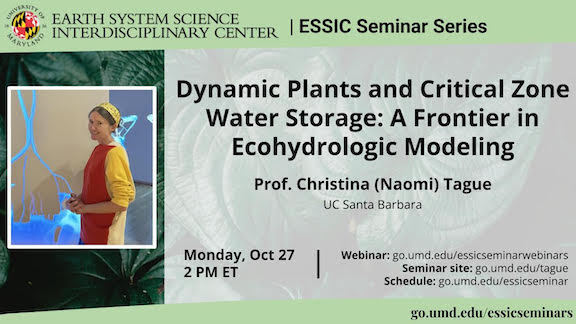
Earth System Science Interdisciplinary Center Seminar Series
Invited Speaker: Professor Naomi Tague
Talk Title: Dynamic Plants and Critical Zone Water Storage: A Frontier in Ecohydrologic Modeling
Date: Monday, October 27
Time: 2:00 PM (Eastern Time)
All are welcome to attend this invited seminar featuring Dr. Naomi Tague, who will discuss advances in ecohydrologic modeling that link dynamic vegetation processes with critical zone water storage.
Webinar link
Zoom Meeting ID: 918 7733 3086
Zoom password: essic
To join the audio conference only: US Toll: +13017158592
Global call-in numbers
Abstract:
Modeling vegetation within hydrologic systems has advanced well beyond early “green slime” representations where vegetation was treated as a static, one-dimensional driver of evapotranspiration. Modern ecohydrology models now represent vegetation as dynamic, sessile organisms that adapt to their environment—through short-term processes such as stomatal regulation and longer-term processes such as strategic carbon allocation to growth. Recent advances also integrate disturbance processes such as fire, allowing us to explore how vegetation actively co-evolves with hydrologic and disturbance regimes.
In this talk, I illustrate how these new classes of models reveal the critical feedbacks between vegetation water use, plant responses to water availability, and the storage capacity of the critical zone. Simple models show that water storage exerts a nonlinear, climate-specific influence on evapotranspiration. More complex models suggest that subsurface storage capacity mediates forest disturbance impacts on transpiration and recovery. Quantifying when and where variation in storage capacity matters provides new insight—but also exposes ongoing challenges in estimating and conceptualizing storage itself. This frontier invites closer synthesis between ecohydrology, geophysics, and plant physiological theory to better understand how dynamic plants shape, and are shaped by, the critical zone.
Biosketch:
Christina (Naomi) Tague’s research uses advanced data science and modeling to understand ecohydrology in a rapidly changing world. She studies how shifts in water availability affect both ecosystems and people—shaping fires, floods, droughts, and the health of rivers and groundwater. Her lab develops simulation models that integrate field, lab, and remote-sensing data to create “virtual laboratories” for exploring what-if scenarios: How will warming affect mountain water supplies? How do vegetation types in green infrastructure influence water and nutrient cycles? How do fuel treatments alter fire severity? Recently, her group has focused on linking Earth system models with interactive visualization tools to advance science communication and decision-making.
 The Tague Team Lab