
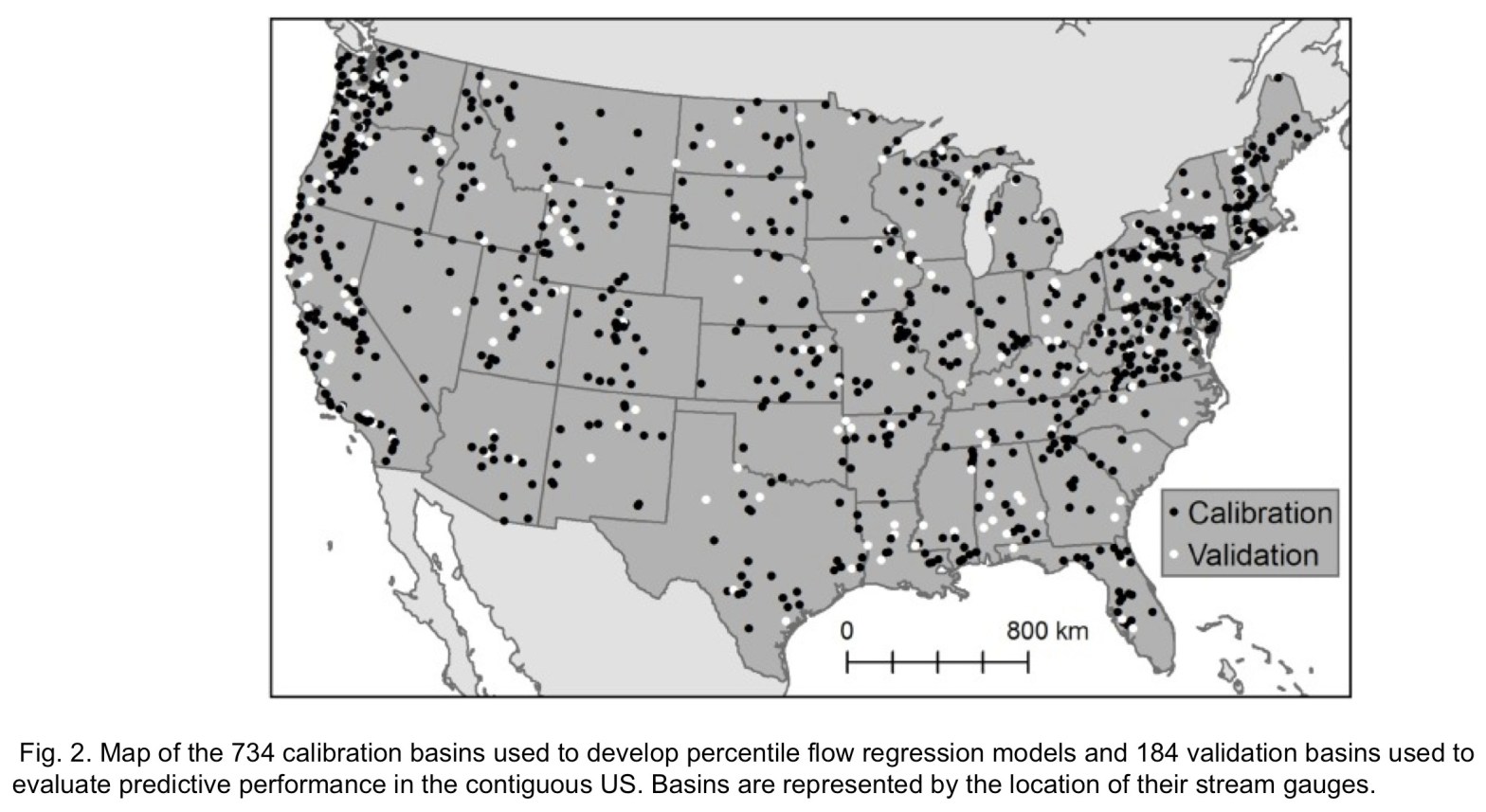
In this new publication, regional regression models using a set of three variables (mean annual precipitation, potential evapotranspiration, and baseflow index) selected via expert assessment was found to be effective in predicting percentile flows and performed similarly to larger sets of variables selected using a data-driven method. Fouad, G., Skupin, A., Tague, C.L. (2018) Regional regressionContinue reading “New Publication!”
Tag Archives: Publications
New approach to model initialization of vegetation published
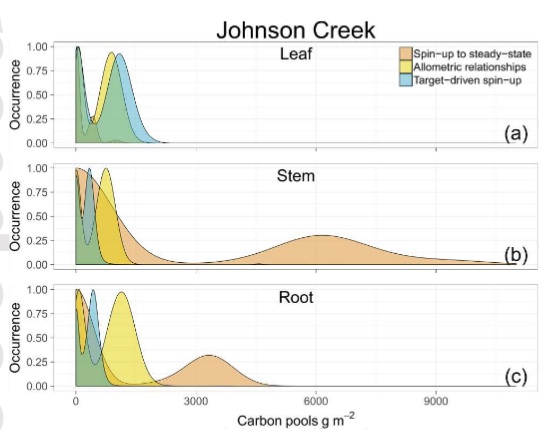
New publication from Tague Team Lab member Dr. Erin Hanan et al. about a new approach for initializing vegetation stores in a watershed model. Typical initialization methods such as spin‐up to steady state (which assumes uniform vegetation age across a landscape) or remote sensing with allometric relationships (which are species and region specific and doContinue reading “New approach to model initialization of vegetation published”
New publication – carbon allocation representation in models

New publication just out in JAMES where RHESSys was used to compare carbon allocation strategies in different grassland sites: “Assessing the Impact of Parameter Uncertainty on Modeling Grass Biomass Using a Hybrid Carbon Allocation Strategy“. Reyes, J. J., Tague, C. L., Evans, R. D., & Adam, J. C. (2017). Assessing the impact of parameter uncertainty onContinue reading “New publication – carbon allocation representation in models”
Fire Spread model linked with RHESSys

New publication on the incorporation of a fire spread model into RHESSys that uses RHESSys outputs to predict fire spread probability. Kennedy, M.C., McKenzie, D., Tague, C., Dugger, A.L. (2017). Balancing uncertainty and complexity to incorporate fire spread in an eco-hydrological model, International Journal of Wildland Fire 26: 706-718. 10.1071/WF16169.
RHESSys used to analyze catchment response to forest thinning – new publication

In this new publication, RHESSys was used to assess the effects of forest thinning on water balance in the central-Sierra American River headwaters. Saksa, P. C., M. H. Conklin, J. J. Battles, C. L. Tague, and R. C. Bales (2017), Forest thinning impacts on the water balance of Sierra Nevada mixed‐conifer headwater basins, Water Resour.Continue reading “RHESSys used to analyze catchment response to forest thinning – new publication”
Urban water conservation in response to drought – new publication

New publication about the ability of water districts to meet mandatory urban water conservation targets. Palazzo, J., O. R. Liu, T. Stillinger, R. Song, Y. Wang, E. H. T. Hiroyasu, J. Zenteno, S. Anderson, and C. Tague (2017), Urban responses to restrictive conservation policy during drought, Water Resour. Res., 53, 4459–4475, doi:10.1002/2016WR020136.
Read all about it: grassland phenology model in RHESSys

A grassland phenology model was embedded in RHESSys to model the phenology of moisture-driven annual grasslands in Mediterranean-type ecosystems in a new publication from Ryan Bart and Naomi Tague (UCSB) with Philip Dennison (U of Utah). Bart, R. R., C. L. Tague, and P. E. Dennison. 2017. Modeling annual grassland phenology along the central coastContinue reading “Read all about it: grassland phenology model in RHESSys”
New Publication!

Tague Team Lab collaborator Colin Bell (CO School of Mines) with Naomi Tague and Sara McMillan (Purdue) have just published the new article “A model of hydrology and water quality for stormwater control measures” in Environmental Modelling & Software. Stormwater Control Measure (SCMs) routines were added to RHESSys to simulate the dynamic hydrologic and water quality processes ofContinue reading “New Publication!”
New Publication

New publication in Ecological Monographs “Nitrogen cycling and export in California chaparral: the role of climate in shaping ecosystem responses to fire“, from Erin Hanan, Naomi Tague, and Josh Schimel. Hanan, E. J., Tague, C. and Schimel, J. P. (2016), Nitrogen cycling and export in California chaparral: the role of climate in shaping ecosystem responses to fire.Continue reading “New Publication”
Chaparral growth-ring analysis as an indicator of stand biomass development

Recent publication in International Journal of Wildland Fire. Uyeda Kellie A., Stow Douglas A., O’Leary John F., Tague Christina, Riggan Philip J. (2016) Chaparral growth-ring analysis as an indicator of stand biomass development. International Journal of Wildland Fire 25, 1086-1092. http://dx.doi.org/10.1071/WF16080
 The Tague Team Lab