Let’s Talk About Water – Film and Discussion

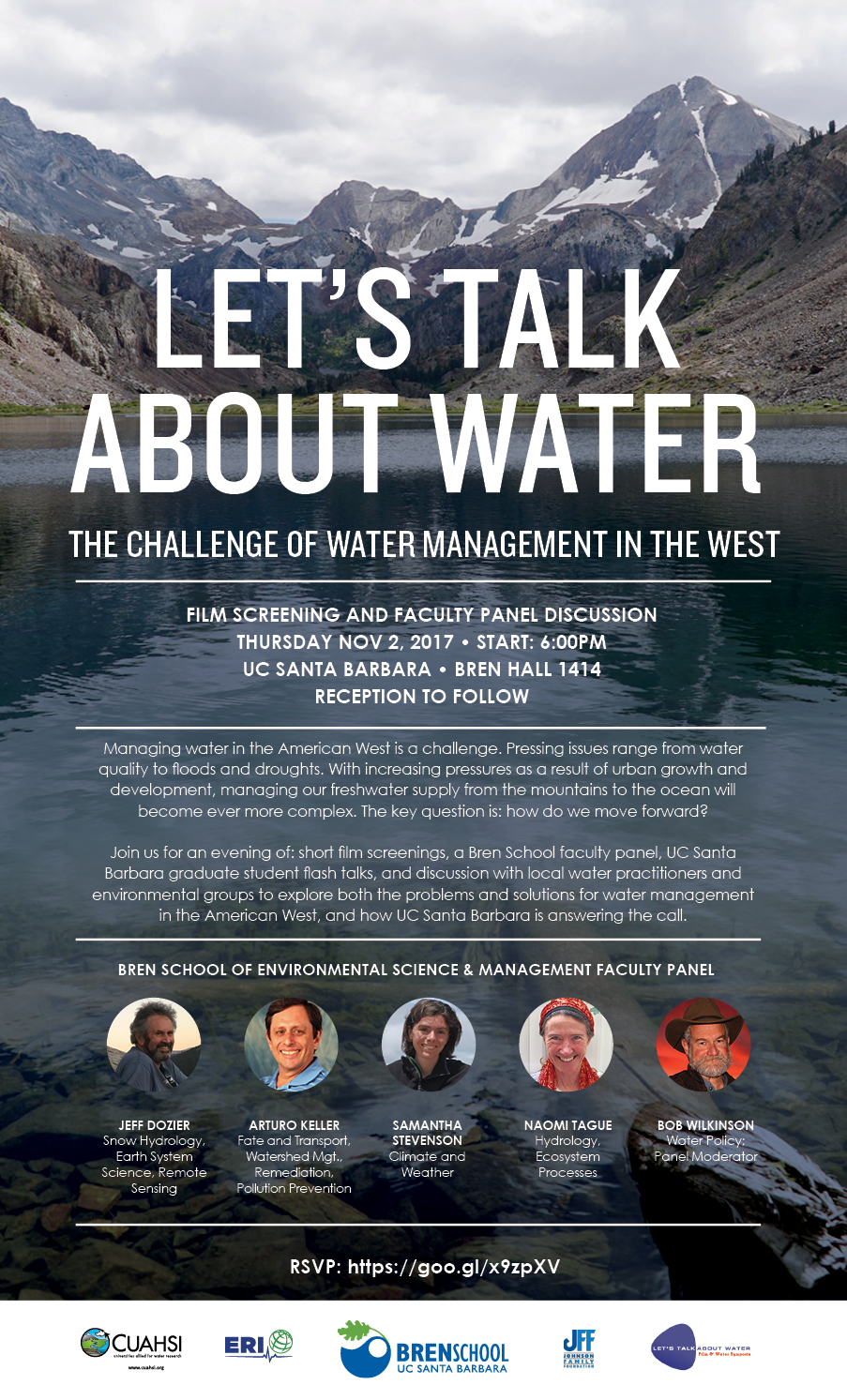
Let’s Talk About Water – The Challenge of Water Management in the West. Come for an evening of short film screenings, a Bren School faculty panel (Naomi Tague, Jeff Dozier, Arturo Keller, Samantha Stevenson and Bob Wilkinson), UC Santa Barbara graduate student flash talks, and discussion with local water practitioners and environmental groups to explore both the problems and solutions for water management in the American West, and how UC Santa Barbara is answering the call.

Please join us for this free event on November 2 from 6:00-8:00 pm, in UCSB Bren Hall 1414, and the reception that follows.
RSVP

RHESSys-Fire Presentation

Last month Naomi Tague presented “Forest responses to drought, climate warming and fire – is there a role for density reduction?” at the Instituto Pirenaico de Ecología (IPE-CSIC) in Huesca, Spain. She met with researchers to introduce the use of RHESSys-Fire as a tool to investigate the impacts that potential thinning strategies may have on forest responses to disturbance.

Fire Spread model linked with RHESSys

New publication on the incorporation of a fire spread model into RHESSys that uses RHESSys outputs to predict fire spread probability.

Kennedy, M.C., McKenzie, D., Tague, C., Dugger, A.L. (2017). Balancing uncertainty and complexity to incorporate fire spread in an eco-hydrological model, International Journal of Wildland Fire 26: 706-718. 10.1071/WF16169.

Hanan Awarded Outstanding Paper Award

Congratulations to Tague Team lab member Erin Hanan on being awarded the Elizabeth Sulzman Award for research conducted while a graduate student, and published within two years of graduation. She received the award for her paper entitled, “Nitrogen cycling and export in California chaparral: the role of climate in shaping ecosystem responses to fire“.

Hanan EJ, Tague C, Schimel JP (2017) Nitrogen cycling and export in California chaparral: the role of climate in shaping ecosystem responses to fire. Ecological Monographs. 87(1):76-90.

RHESSys used to analyze catchment response to forest thinning – new publication

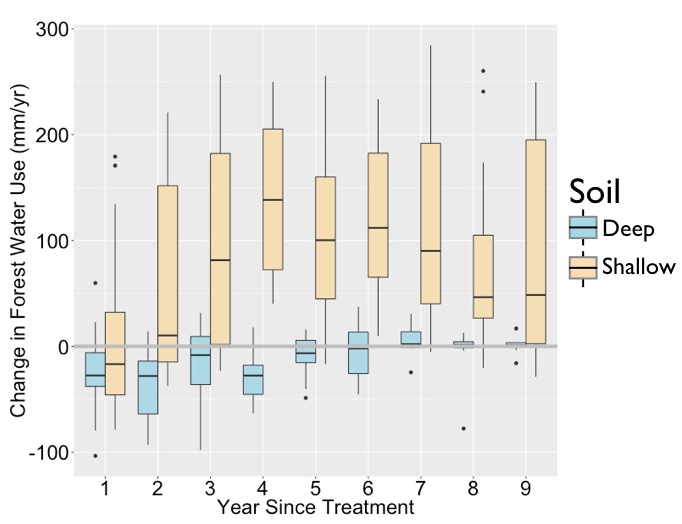
In this new publication, RHESSys was used to assess the effects of forest thinning on water balance in the central-Sierra American River headwaters.

Saksa, P. C., M. H. Conklin, J. J. Battles, C. L. Tague, and R. C. Bales (2017), Forest thinning impacts on the water balance of Sierra Nevada mixed‐conifer headwater basins, Water Resour. Res, 53(7), 5364–5381, doi:10.1002/2016WR019240.

Urban water conservation in response to drought – new publication

New publication about the ability of water districts to meet mandatory urban water conservation targets.

Palazzo, J., O. R. Liu, T. Stillinger, R. Song, Y. Wang, E. H. T. Hiroyasu, J. Zenteno, S. Anderson, and C. Tague (2017), Urban responses to restrictive conservation policy during drought, Water Resour. Res., 53, 4459–4475, doi:10.1002/2016WR020136.

Summer Wildfire Seminar

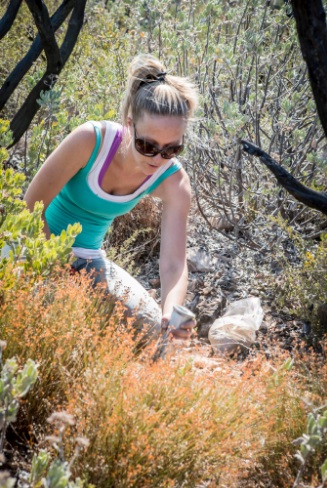
Naomi Tague and fellow UCSB professors Andrew Plantinga and Sarah Anderson, as well as Max Moritz of UC Berkeley and Maureen Kennedy of the University of Washington taught a summer seminar at UCSB earlier this month on managing wildfire. The SERI Fire hosted program provided a taste of interdisciplinary research through lectures on wildfire management, applied data analysis, and natural systems modeling techniques, as well as field trips to Sedgwick Reserve and the site of the recent Whittier Fire burn area. Six students from various institutions across the country and from diverse backgrounds and areas of study participated and produced a collaborative poster on wildfire management.

Read the story recently reported in The UC Santa Barbara Current

Critical Zone Observatory Annual Meeting

This week many of our lab group attended the Sierra Critical Zone Observatory Annual Meeting in at the Center Sierra Historical Society near Shaver Lake. We spent the day in science meetings and camped by Shaver Lake at night. From our group, Ryan Bart presented on the new fire effect model that he has developed as part of our SERI-Fire project. Ethan on his Entering Wildfire work and the design for new visualization of RHESSys output. Chris Heckman’s poster linked water use and storage for sites across the CZO network.


Read all about it: grassland phenology model in RHESSys

A grassland phenology model was embedded in RHESSys to model the phenology of moisture-driven annual grasslands in Mediterranean-type ecosystems in a new publication from Ryan Bart and Naomi Tague (UCSB) with Philip Dennison (U of Utah).
Bart, R. R., C. L. Tague, and P. E. Dennison. 2017. Modeling annual grassland phenology along the central coast of California. Ecosphere 8(7):e01875. 10.1002/ecs2.1875