New Publication: climate vs. fuel-limitations in watershed fire regimes

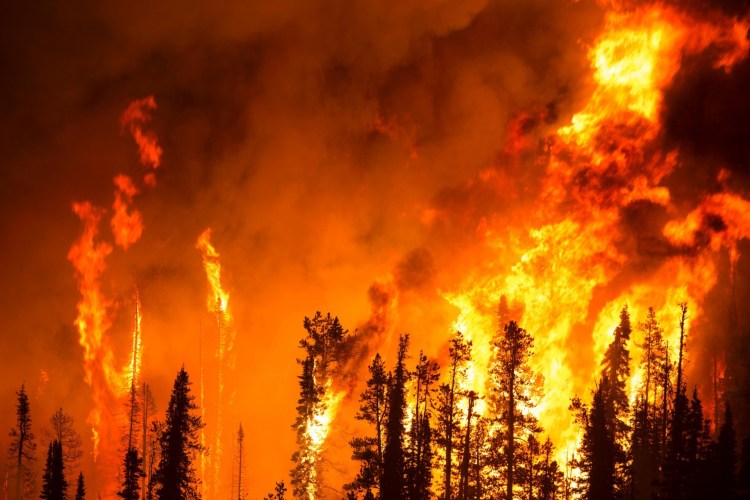
In this new publication “How climate change and fire exclusion drive wildfire regimes at actionable scales” , the authors modeled the drivers that dominate fire regimes at management-relevant scales, finding that spatial estimates of soil aridity can provide a relatively simple, first-order indicator of where in a watershed fire regime is climate vs. fuel-limited and where fire regimes are most vulnerable to change.

Hanan, E.J., Ren, J., Tague, C.L., Kolden, C.A., Abatzoglou, J.T, Bart, R.R., Kennedy, M.C., Liu, M., Adam, J.C. (2020) How climate change and fire exclusion drive wildfire regimes at actionable scales, Environmental Research Letters doi: 10.1088/1748-9326/abd78e

New publication: interactions between biophysical & climatic parameters and fuel treatments

In this new publication “Understanding How Fuel Treatments Interact With Climate and Biophysical Setting to Affect Fire, Water, and Forest Health: A Process-Based Modeling Approach“, RHESSys is used to model effects across a range of fuel treatment types, biophysical, and climate parameters on stand carbon, net primary productivity, evapotranspiration, and fire-related canopy structure variables.

Burke, W.D., Tague, C., Kennedy, M.C., Moritz, M.A. (2021) Understanding How Fuel Treatments Interact With Climate and Biophysical Setting to Affect Fire, Water, and Forest Health: A Process-Based Modeling Approach, Front. For. Glob. Change 3: 143pp. doi.org/10.3389/ffgc.2020.591162

New publication on urban energy balance

In this new publication, the authors examine urban energy flux variability across landcover and climate gradients of urbanized Los Angeles County by using high resolution remote sensing combined with spatially distributed simulations with an urban energy balance model, covering the complete diurnal cycle of the remote sensing flights.

Wetherley, E.B., Roberts, D.A., Tague, C.L., Jones, C., Quattrochi, D.A., McFadden, J.P. (2021) Remote sensing and energy balance modeling of urban climate
variability across a semi-arid megacity, Urban Climate 35: 100757. doi.org/10.1016/j.uclim.2020.100757

Visualization and Ecohydrologic Models: Opening the Box

In this new publication “Visualization and ecohydrologic models: Opening the box“, authors Naomi Tague and James Frew outline a framework for increasing the usefulness of ecohydrologic models through better visualization. Paper published as early view in Hydrological Processes special issue “WOMEN ADVANCING RESEARCH IN HYDROLOGICAL PROCESSES”.

Tague, C., Frew, J. (2020) Visualization and ecohydrologic models: Opening the box, Hydrological Processes 1– 13. doi.org/10.1002/hyp.13991

David Miller’s Defense

Remote Sensing of Urban Vegetation during Drought in Southern California

UCSB Geography PhD student and Tague Team Lab member David Miller’s Final Defense will be on Friday, December 4, 2020 at 12:00 PM (PST) via Zoom (contact us for connection information)

Advisor: Joe McFadden

Committee Members: Dar Roberts and Naomi Tague


Abstract: During 2012-2016, California experienced one of the most severe droughts in its modern history, with limited precipitation and exceptionally high temperatures over an extended time period. Urban vegetation, such as trees and turfgrass lawns, provides many benefits, or ecosystem services, for people living in cities. For example, urban plants can cool their surroundings through shading and latent heat loss from evapotranspiration. These benefits may be difficult to maintain through extreme drought, especially in water-limited cities, and different types of vegetation may have different responses to drought. In this dissertation, I used remote sensing time series to quantify how urban vegetation responded to drought in Santa Barbara and Los Angeles, California.

In Chapter 1, I examined drought response in turfgrass and across nineteen urban tree species in the city of Santa Barbara using data from repeat flights of the Airborne Visible Infrared Imaging Spectrometer (AVIRIS) and AVIRIS-Next Generation (AVIRIS-NG). I compared many spectral indicators that may be expected to change within plant canopies during drought.

In Chapter 2, I evaluated how drought manifests seasonally and interannually during 2010-2019 across dominant types of trees and grass in the Santa Barbara area using Landsat and AVIRIS imagery. I compared the condition of dominant types of trees and grasses as they changed throughout the year using the Normalized Difference Vegetation Index (NDVI), difference in vegetation land surface temperature from impervious surfaces (∆LST), and equivalent water thickness (EWT). I also assessed the correlations of NDVI and ∆LST with the Standardized Precipitation Evapotranspiration Index (SPEI) to test to the effects of drought length and severity on vegetation.

In Chapter 3, I assessed annual changes in fractional cover of trees, turfgrass, non-photosynthetic vegetation (NPV; e.g., senesced grass, plant litter), and non-vegetated urban surfaces across the Los Angeles metropolitan area during 2013-2018 using AVIRIS imagery. I also compared vegetation changes based on median household income and estimates of outdoor water use.


Tague Presents at Drylands, Deserts, and Desertification Conference

Last week, Naomi Tague presented “Understanding forests in a warming world through model-data integration” at the The 7th International Feeding the Drylands: Challenges in Changing Environment conference at the Ben-Gurion University of the Negev. The conference addresses four sustainable development goals: food, water, human, and ecosystem challenges.

Hanan’s commentary on Megafires

Dr. Erin Hanan – assistant professor of fire ecology and director of the Fire & Dryland Ecosystems Lab in the Department of Natural Resources and Environmental Sciences at UNR – wrote the commentary “Megafires: Climate change or land management?” as a guest blogger for the Niskanen Center. This timely commentary addresses the debate on fires in the West – are they due to climate change, or due to forest mismanagement?

New Publication! Snow, runoff, and counteracting influences

This research highlights how runoff losses/gains due to changes in snow dynamics (amount, melt, timing) as a result of climate change are mediated by site specific conditions such as vegetation use, subsurface characteristics, and energy availability.

Barnhart, T. B., Tague, C. L., & Molotch, N. P. (2020). The counteracting effects of snowmelt rate and timing on runoff. Water Resources Research, 56, e2019WR026634. https://doi.org/10.1029/2019WR026634