Postdoctoral Scientist in Montane Forest and Snow Hydrology at the University of Nevada, Reno
Posting: We seek a dynamic and innovative postdoctoral scientist that works at the intersection of snow and forest hydrology in mountain systems. Our project seeks to understand the potential role of landscape-scale forest thinning on the west shore of Lake Tahoe and Sagehen Creek watershed on snowpacks and streamflow dynamics. The project combines innovative use of hydrological models, remote sensing, and field work to tackle critical management questions critical to the future of montane forests. The candidate would be based primarily out of the Nevada Mountain Ecohydrology Lab at the University of Nevada, Reno (UNR) The project is a collaboration between UNR, the Desert Research Institute, and the University of California, Santa Barbara, and will include travel to the Tague Lab at UCSB . A variety of physically-based models will be employed for investigations at different spatial and temporal scales, including snowpack energy budget (SnowPALM), hydrological (GSFLOW), and ecohydrological (RHESSys) models. Ideal candidates would combine expertise in modeling, data analysis, and field data collection. Candidates with experience in snowpack energy budget modeling or RHESSys type ecohydrological modeling are preferred. Demanding field work may be necessary. The project requires interacting and collaborating with a large team, including resource managers and scientists that will require excellent communication and interpersonal skills.
Qualifications:
Ph.D. in hydrology related field such as engineering, environmental science, or forestry required by start date. Experience with hydrological modeling platforms and related scripting/coding required in model application and development.
Details:
The position is potentially extendable to 30 months. The desired start date is August 1st. The salary and benefits are competitive for Reno’s cost of living.
The University of Nevada, Reno is the State of Nevada’s land grant and historic flagship institution of higher. Located in the Truckee Meadows at the base of the Sierra Nevada to the west with the Intermountain West to the east, the University of Nevada, Reno, is 45 minutes from Lake Tahoe. Numerous outdoor activities can be found in and adjacent to the city, including skiing, mountain biking and trails, water sports, and other mountain sports. The region is also home to many culturally and socially rich activities, including the Reno Philharmonic and Chamber orchestras, the Nevada Museum of Art, and Reno Artown; Shakespeare, Jazz, Reno/Tahoe Music, Nevada Chamber Music, Pacifica, Aloha, Cinco de Mayo, Basque, Sculpture, and River Festivals to name just a few; Hot August Nights and Street Vibrations; the Reno Balloon Race, and many other diverse events and traditions. Northern Nevada is home to a growing food culture, with many small farms feeding the farm to table movement and local restaurants, including a dozen micro-breweries/distillers/vintners in the region.
To apply:
Please send an email to aharpold@cabnr.unr.edu with subject line: “Application for WCB postdoctoral scientist position” that includes a CV and a short (one page) letter about your qualifications and interest for the position. Review of applications will be begin May 1 and will be open until filled.


 Congratulations to Tague Team Lab member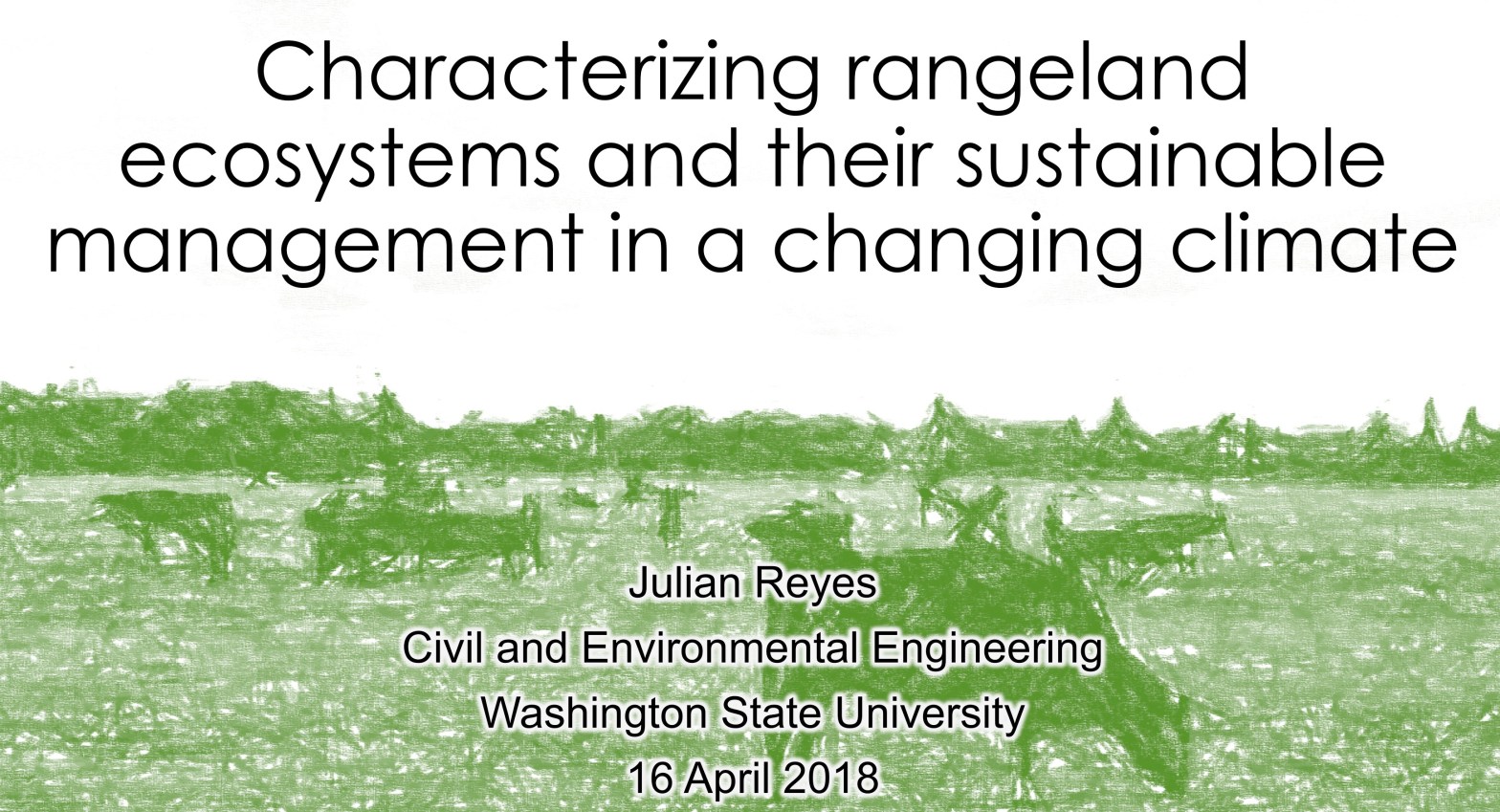
 We congratulate Julian Reyes, PhD student in Civil and Environmental Engineering at Washington State University – and Tague Team Lab friend and collaborator – on successfully defending his PhD “Characterizing rangeland ecosystems and their sustainable management in a changing climate”. Dr. Reyes developed a
 The Tague Team Lab